
The Nova Scotia Court of Appeal has dismissed a man’s bid to reverse the revocation of his personalized licence plate bearing his surname, “Grabher.”
Lorne Grabher’s licence plate was revoked by the province’s Registrar of Motor Vehicles in December 2016 after it said the word could be misinterpreted as a socially unacceptable slogan.
That sparked a legal battle that culminated this week with a ruling from the Nova Scotia Court of Appeal, on the grounds that his right to freedom of expression had been violated., however, the province’s highest court upheld a Nova Scotia Supreme Court decision that Grabher’s constitutional rights were not violated by cancelling his plate.
Lawyers for Lorne Grabher filed for an appeal in January The “GRABHER” licence plate, Bourgeois noted, could in fact be interpreted as a call to gender-based violence.
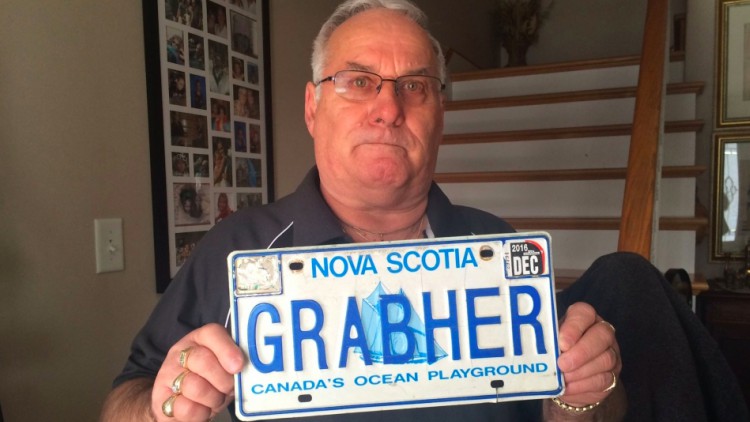
An email that was sent to CBC News by a spokesman from the Department of Transportation (DOT) stated, “A complaint was received outlining how some individuals interpret [the name] as misogynistic and promoting violence against women.”
But Grabher refuses to bend for the PC police. He said the license plate was a gift from his father. And he wants to proudly display his name while driving.
But Canada wants him to stop.
The statement from the DOT stated, “With no way to denote that it is a family name on the plate, the department determined it was in the public’s best interest to remove it from circulation.”
Grabher is prepared to fight tooth and nail to keep the plate.
His lawyer said, “We aren’t going to be suing for damages or monetary compensation. We just want a reversal of the government’s unjust decision.”
Nova Scotia’s RMV has a strict policy about its license plates. Their website states that car owners must use plates with “Words or symbols socially unacceptable, offensive, not in good taste, or implying an official authority.”
But since this plate is Grabher’s last name, an exception could be the right call.
Until he received this challenge to his plate, Grabher has dutifully paid the annual fees required of him to maintain his vanity plate. Should he be allowed to keep it?
However, the appeal court decision released Tuesday, said Justice Darlene Jamieson made no error in law in her ruling to uphold the province’s decision.
Grabher, who had the licence plate for 27 years, had argued the decision to revoke his plate violated his right to freedom of expression and also infringed on his rights as a Canadian of Austrian-German descent.
The court determined that licence plates are not principally meant for self-expression and there are other avenues open to Grabher, such as bumper stickers.
The court also noted that the same opportunity is not available to everyone, only to those who can condense their message to the seven characters — the character limit on the Nova Scotia licence plate.
Those characters are further restricted to numbers and the 26 letters of the Roman alphabet.
The court of appeal said a further restriction on vanity plates is that each one must be unique, so people with common surnames like Smith or LeBlanc would not be able to put their name on a plate.
The court agreed with Jamieson that without the proper context, the word “Grabher” could be taken as offensive to some people.
Grabher was represented in his appeal by lawyers from the Calgary-based Justice Centre for Constitutional Freedoms, the same group whose former president hired a private detective to surveil a Manitoba judge.
Jay Cameron, the main lawyer representing Grabher in his constitutional challenge, was not involved in hiring the detective but became aware of the surveillance a couple of weeks before it was publicly revealed by the judge.